Brake line installation quality is governed by how the tubing material responds to plastic deformation during cutting, bending, flaring, and final tightening. Copper-nickel and steel brake lines differ significantly in ductility, stiffness, and yield behavior, and these differences directly influence workmanship sensitivity and sealing reliability during installation.
Copper-nickel tubing has lower yield strength and higher ductility than low-carbon steel tubing. This allows the tube to bend and conform to routing paths with reduced risk of kinking, particularly when navigating around suspension components, axles, frames, and brake control modules. The material flows plastically at lower forming loads, which reduces localized strain concentration during bending.
This behavior improves installer control during hand forming but also means the tubing is more susceptible to deformation if unsupported or subjected to repeated bending during installation. Steel tubing retains higher stiffness, which limits unintended deflection once installed but requires greater bending force. Higher forming force increases the likelihood of springback, uneven bend radii, and surface damage, particularly where polymer or metallic coatings are present.
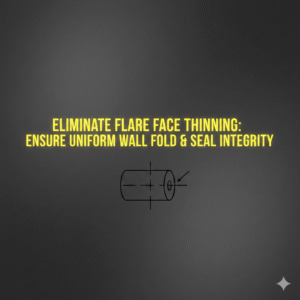
Brake line flaring is a controlled plastic deformation process that forms the tube end into a sealing surface that mates with the fitting seat. Proper sealing requires uniform material flow, concentricity, and surface integrity at the flare face. Leaks occur when the flare is uneven, cracked, misaligned, or contaminated, preventing full contact between the flare and the fitting seat under tightening load. Copper-nickel tubing deforms more easily during flaring because of its lower yield strength.
Less forming force is required to expand the tube end, which reduces the likelihood of splitting at the flare lip. However, the same ductility increases sensitivity to over-forming. Excessive force can thin the flare wall, distort the sealing angle, or create an over-expanded flare that does not seat correctly. These defects typically appear at the flare face where the tube contacts the fitting.
Steel tubing requires higher forming force due to greater stiffness and strength. Increased force raises the likelihood of tool slippage or uneven deformation if the tube is not rigidly clamped in the flaring bar. Incomplete forming, surface tearing, or galling can occur at the flare cone and sealing face when friction between the tool and tube wall is excessive. These surface defects reduce sealing effectiveness and can propagate into cracks under hydraulic pressure.
Tube preparation directly affects flare quality. A square tube cut is required to ensure uniform material flow during flare formation. Cuts that are angled or distorted cause asymmetric deformation during forming. Burrs left on the inner or outer tube edge interfere with material flow and create localized stress concentrations at the flare lip.
These stress concentrations can initiate cracks that grow under pressure cycling. Deburring and light chamfering reduce resistance during flare expansion and allow the tube wall to fold evenly, producing a concentric sealing surface. Improper preparation is most evident at the flare edge and mating seat, where uneven wall thickness or surface irregularities prevent full contact.
Double flares are commonly used in automotive brake systems to improve sealing reliability and strength. The first forming step folds the tube end inward, and the second step shapes the final sealing angle. Correct tube height, alignment, and tool positioning are critical during both steps. Incorrect tube protrusion or misalignment during either operation results in uneven wall thickness, off-center flares, or distorted sealing angles. These defects concentrate stress at the fitting interface and increase leakage risk.
Tool interaction plays a critical role in flare integrity. Lubrication of the flaring tool cone reduces friction between the tool and tubing, limiting galling and surface tearing during deformation. Galling damage appears as rough or torn surfaces on the flare face and directly compromises sealing. Proper clamping force on the flaring bar is required to prevent tube movement without crushing or deforming the tube wall.
Final tightening compresses the flare against the fitting seat to form a hydraulic seal. Copper-nickel flares require less tightening force because the material conforms readily to the seat geometry. Steel flares require higher tightening force to achieve full surface contact due to greater stiffness. Over-tightening either material can distort the flare, thin the sealing edge, or embed defects into the seat, resulting in leakage. Under-tightening prevents full contact and allows micro-movement at the joint under pressure cycling.
In busy repair environments such as Dutchess County Automotive Services on Salt Point Turnpike, where sectional brake line repairs on older vehicles are common, even slight misalignment during hand-bent replacements can preload the flare with side stress before the vehicle ever leaves the bay.
Installation workmanship directly influences long-term sealing performance. Misalignment between the tube and fitting places bending stress on the flare during tightening and service. Residual stress at the flare interface accelerates crack initiation, particularly under vibration and pressure cycling. Proper routing, alignment, and controlled forming reduce stress concentration at flare transitions and joints, improving seal integrity and service life in both copper-nickel and steel brake line installations