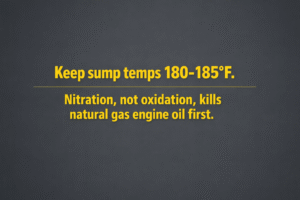
For maintenance professionals, extending oil service intervals in natural gas engines depends on managing the primary chemical pathways of **oil degradation**: nitration and oxidation. In this application, nitration is typically the limiting factor for drain intervals.
Oxidation occurs when base oil reacts with oxygen at elevated temperatures, generally above 200°F (95°C). Nitration is a separate process involving nitrogen oxides (NOx)—specifically nitrogen dioxide (NO₂)—from combustion. These gases enter the crankcase via blow-by, where they react with oil hydrocarbons to form organic nitrates and nitrites. This leads to the formation of **varnish**, sludge, carbon deposits, and, in advanced stages, oil thickening and solidification.
The rate of these degradation reactions is thermally driven. A standard industry kinetic model holds that the oxidation rate approximately doubles for every 18°F (10°C) increase in **sump temperature**. Therefore, operational control of the oil temperature is a critical maintenance lever. The target range for minimizing the rate of both nitration and oxidation is 180°F to 185°F (82°C to 85°C). Exceeding 185°F (85°C) significantly accelerates degradation. It is noted that nitration rates are also influenced by combustion tuning, often peaking at air-to-fuel ratios near 18:1 or 19:1.
The definitive method for determining oil change intervals is condition-based monitoring through used **oil analysis**, moving beyond fixed hourly schedules. Oil life is condemned based on four established parameters. First, viscosity increase, measured per ASTM D445, serves as a primary indicator; an increase of 25% to 30% above the new oil specification signals advanced degradation. Second, nitration is directly quantified via FTIR Spectroscopy in absorbance per centimeter (abs/cm), with a typical alarm threshold at 20–25 abs/cm, though a sharp upward trend is a more critical indicator than any single absolute value. Third, the Total Base Number (TBN) measures the remaining alkaline reserve, and a reduction to 50% of the new oil’s value generally signals the additive package’s end of useful life. Fourth, the Total Acid Number (TAN) gauges acidic byproducts; the oil is considered corrosive and spent when the used oil TAN reaches double the new oil’s value or when the TAN exceeds the remaining TBN.
Oil consumption rate directly impacts these chemical limits. A high makeup oil rate continuously replenishes fresh additives, which can artificially extend the effective life of the oil in the sump. Conversely, a system with very low consumption provides no such replenishment, often leading to a shorter viable **drain interval** as additives are depleted and nitration products concentrate.
Fuel quality is another operational variable. Engines running on sour gas, landfill gas, or biogas containing hydrogen sulfide and halogens will produce acidic combustion byproducts that aggressively neutralize the oil’s alkaline reserve (TBN). In these environments, selecting an oil with a higher initial TBN or implementing a more compressed oil analysis schedule is necessary to prevent corrosive wear.
Summary for MRO Practice: Maximizing oil life is a function of controlling operating temperature, monitoring oil consumption, and adhering to a strict used oil analysis program based on the condemning limits for viscosity, nitration, TBN, and TAN. This data-driven approach allows for optimized drain intervals that ensure reliability without prematurely discarding serviceable oil.